
Start a Cosmetics Online Shop: A Legally Sound Launch for Small Producers
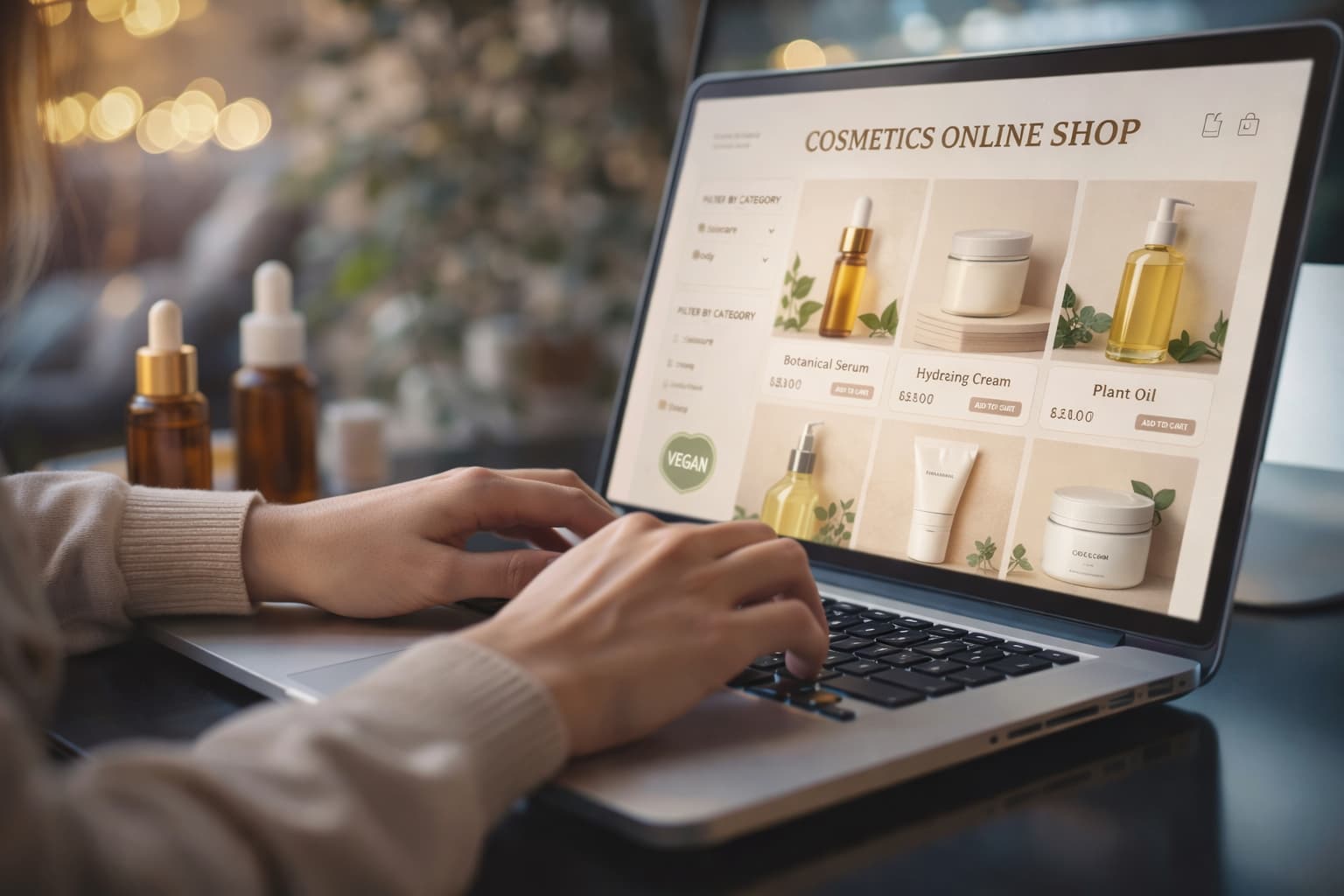
Your cosmetic product is fully formulated, the safety assessment has been passed and the CPNP notification submitted – now you want to open your cosmetics online shop and sell your handmade cosmetics. But which platform suits you? What has to appear on the product page for legal reasons? And how do you avoid costly legal warnings?
This hands-on guide shows you step by step how to build your cosmetics online shop on a sound legal footing: from the platform comparison through the legal notice, withdrawal policy and GDPR to product pages, shipping, marketing and a launch checklist. Especially for small producers who want to sell their own cosmetics online.
Haven’t registered a business yet? Then first read our guide to registering a home cosmetics business. And if you’re not yet familiar with the legal basics of selling cosmetics, start with our guide: how to sell homemade cosmetics legally.
Platform comparison: Etsy vs. Shopify vs. your own shop
The first decision when selling cosmetics online: where do you build your shop? Every platform has strengths and weaknesses. Here is the overview:
| Criterion | Etsy | Shopify | WooCommerce |
|---|---|---|---|
| Fixed costs / month | 0 € (fees only) | from 36 € | from 5–20 € (hosting) |
| Transaction fees | 6.5 % + 0.30 € | from 1.9 % + 0.25 € | payment fee only |
| Setup effort | Very low (1–2 hrs) | Low (1–2 days) | High (technical) |
| Design freedom | Heavily restricted | Good (themes) | Full control |
| Own domain | No (etsy.com/shop/...) | Yes | Yes |
| Reach / traffic | High (marketplace) | Build it yourself | Build it yourself |
| Ideal for | A quick start | Growing brands | Tech-savvy users |
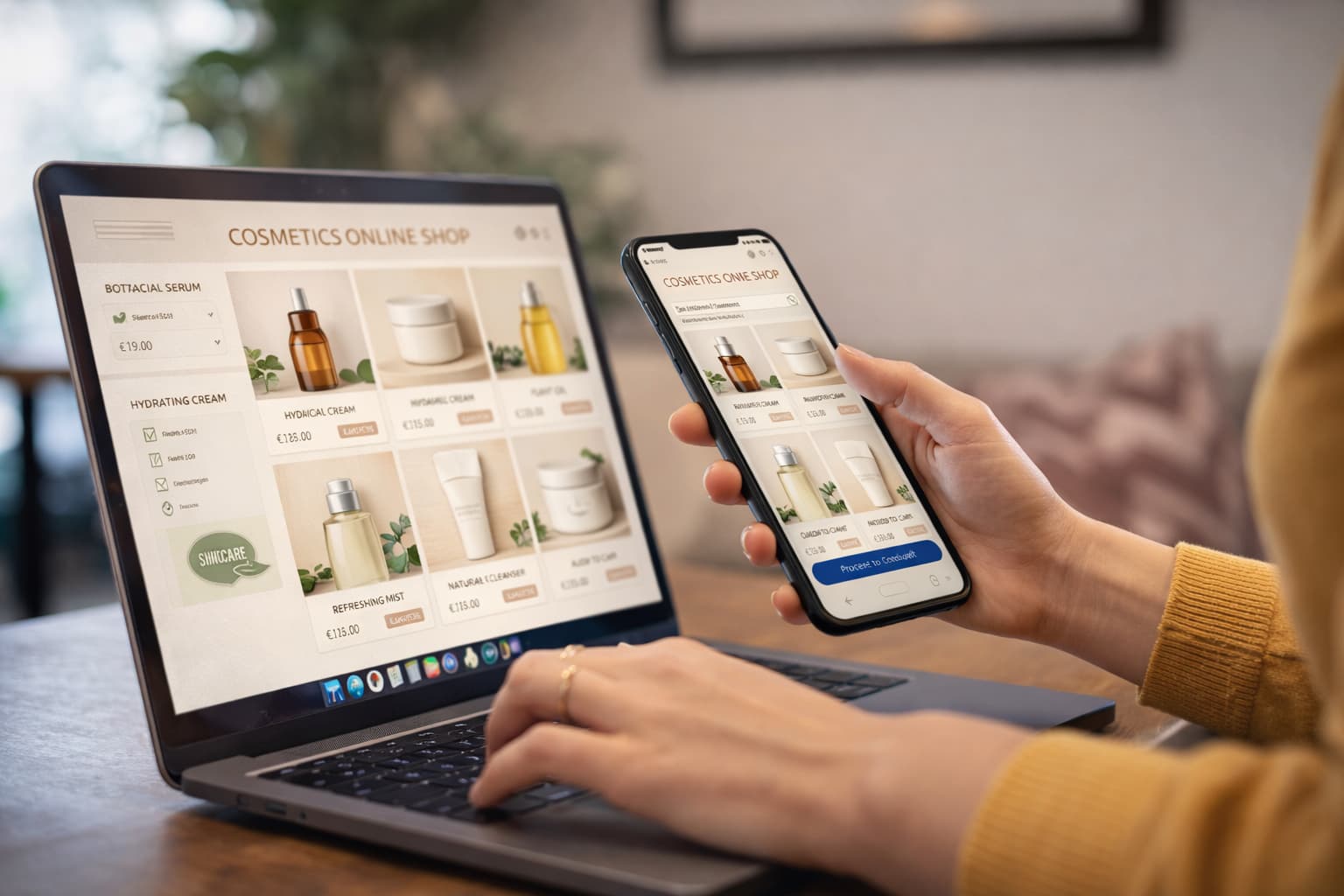
Your cosmetics shop should work equally well on desktop and smartphone
Our recommendation for beginners
Start with Etsyto test your product and your target audience – with no fixed costs and built-in traffic. As soon as you are selling regularly and want to build your brand, switch to Shopify. We only recommend running your own WooCommerce shop once you have technical experience or a budget for a developer.
Legal obligations for your online shop
Anyone who wants to sell cosmetics onlinehas to meet a range of legal requirements. Mistakes in this area quickly lead to legal warnings – and these usually cost upwards of 1,000 €. Here are the four most important obligations:
Legal notice (imprint)
Every commercial online shop needs a complete legal notice (often called an imprint). Under EU e-commerce law it must be reachable from every page in no more than two clicks. Mandatory details: name, address, contact details (email + phone or contact form), commercial register number (if applicable) and VAT ID (if applicable).
Right of withdrawal
As an online retailer you must inform consumers about their 14-day right of withdrawal (EU distance-selling rules). This information must be provided beforethe purchase – not only in the confirmation email. It is best to use a legal-text generator such as Händlerbund, IT-Recht Kanzlei or Trusted Shops to obtain legally sound texts.
Caution: cosmetics and the right of withdrawal
For cosmetic products whose seal has been removed after delivery, the right of withdrawal can be excluded (EU consumer law allows this for sealed goods that are unsuitable for return for reasons of health or hygiene). This must, however, be explicitly mentioned in the withdrawal policy, and the seal must be clearly recognisable.
Privacy policy (GDPR)
Your shop collects personal data (name, address, email, payment data). You need a GDPR-compliant privacy policy that describes all processing purposes, legal bases, retention periods and data-subject rights. In addition: a cookie banner (if you use tracking), data-processing agreements with your service providers (payment, shipping, analytics) and, where applicable, a record of processing activities.
Terms and conditions
Terms and conditions are not legally required – but strongly recommended. They govern delivery times, payment terms, liability disclaimers and warranty. The same applies here: use a legal-text generator or seek advice from a lawyer. Self-written terms almost always contain invalid clauses.
Building product pages the right way
Your product page is the heart of your shop. It has to fulfil two jobs at once: selling (convincing the customer) and meeting legal obligations (labelling under the EU Cosmetics Regulation). Here are the most important elements:
INCI list (mandatory)
The complete ingredient list must appear on the product page. Use the correct INCI nomenclature and the right order (descending by concentration). Details in our INCI guide.
PAO symbol (Period After Opening)
The open-jar symbol with the shelf life after opening (e.g. 6M, 12M) must appear on the packaging. In your online shop you should also mention it in the product description.
Warnings
Certain ingredients require warnings (e.g. essential oils, allergens, UV filters). These must appear both on the packaging and in the online description.
Nominal content (weight/volume)
The fill quantity must be stated on the product page – in grams or millilitres. Make sure to state it correctly with the unit (e.g. “50 ml” or “100 g”).
High-quality product images
Show your product from several angles, in use and with a size reference. Natural light, a consistent style, at least 3–5 images per product. The images must show the real product – no stock photos.
Product description
Describe application, scent, texture and target audience. Avoid medicinal claims (more on that later). Tell the story behind the product – that is your advantage over large manufacturers.
For the correct INCI list, our step-by-step guide to INCI declaration will help you. And for product-safety documentation you need a complete Product Information File (PIF).
Sort INCI lists automatically and manage product data
INCIkit creates your INCI declaration automatically from the formulation, manages raw materials with LOT numbers and documents everything in a GMP-compliant way – the perfect basis for professional product pages.
Shipping & packaging law
As soon as you ship products to end consumers, packaging law applies. It covers every type of packaging: product packaging, shipping box, filler material, adhesive tape. Here are the three most important obligations:
1. Packaging-register registration
Across the EU, anyone who first places packaging on the market must register with their national packaging register. In Germany this is the LUCID register. Registration is free and can be done online at lucid.verpackungsregister.org. Your registration number must appear in the legal notice.
2. Joining a compliance scheme
In addition to registering, you must join an Extended Producer Responsibility scheme (in Germany, for example, Der Grüne Punkt, Interseroh+ or BellandVision). Depending on the volume of packaging, this costs around 20–100 €/year for small quantities. You report your annual packaging volumes (weight by material: cardboard, plastic, glass) and pay a licence fee.
3. Choosing a shipping provider
For shipping cosmetics, providers such as DHL (one of the cheapest options for small parcels), GLS and DPD work well. Make sure to use secure packaging: glass jars need padding, and liquid products should be packed leak-proof. Offer carbon-neutral shipping where possible – it fits the target audience.
Important: fines for missing packaging registration
Without registering in the packaging register, you risk a distribution ban and a fine of up to 200,000 € (in Germany). The packaging-register authority carries out regular checks – including small Etsy shops. Registration takes only 15 minutes and is free.
Advertising & claims: what you are allowed to say
Advertising for cosmetics is strictly regulated. The EU Cosmetics Regulation (EC) 1223/2009 and unfair-competition law set clear limits. Breaches lead to legal warnings or authority proceedings.
Permitted claims (cosmetic effect)
- “Nourishes dry skin” – cosmetic care claim, permitted
- “Provides moisture” – cosmetic effect, permitted
- “Protects against dryness” – cosmetic protective effect, permitted
- “With organic shea butter and jojoba oil” – naming ingredients, permitted
- “Handmade in Germany” – statement of origin, permitted (if true)
Prohibited claims (medicinal/misleading)
- “Cures acne”– medicinal effect, prohibited (medicinal-advertising law)
- “Anti-ageing miracle”– exaggerated efficacy promise, prohibited (unfair-competition law)
- “Clinically tested”– only permitted if you can present a genuine clinical study
- “100 % natural”– prohibited if the product contains even a single synthetic preservative
- “Dermatologically tested”– only permitted if the test was actually carried out and documented
Anyone who wants to use natural-cosmetics claims should also look into the various natural-cosmetics certifications – a recognised seal protects against legal warnings and strengthens trust.
Payment & accounting
The right payment processing is crucial for conversion and customer satisfaction. Customers expect certain payment methods:
PayPal
One of the most popular online payment methods in Europe. A must for every online shop. Fees: around 2.49 % + 0.35 € per transaction.
Credit card (Stripe / Mollie)
Important for international customers. Stripe and Mollie offer easy integration and transparent fees (around 1.4 % + 0.25 € for EU cards).
Pay by invoice (Klarna / Billie)
Very popular in Europe – the buyer only pays after receiving the goods. Increases conversion but costs higher fees.
Instant bank transfer / Giropay
A direct bank transfer. Familiar to European customers, with lower fees than PayPal.
Accounting and invoicing obligations
As a business owner you must issue proper invoices (under EU VAT rules). Every invoice needs: a sequential number, your address and tax number, the buyer’s name and address, the delivery date, individual line items with net price, the tax rate and the gross amount. Use an accounting tool such as sevdesk, lexoffice or Billomat. If you qualify for a small-business VAT exemption, you are exempt from charging VAT – but you must note this on every invoice.
Marketing tips: SEO & social media
The most beautiful shop is worthless if no one finds it. As a small producer you rarely have a large advertising budget – which makes organic channels, bringing traffic over the long term and for free, all the more important.
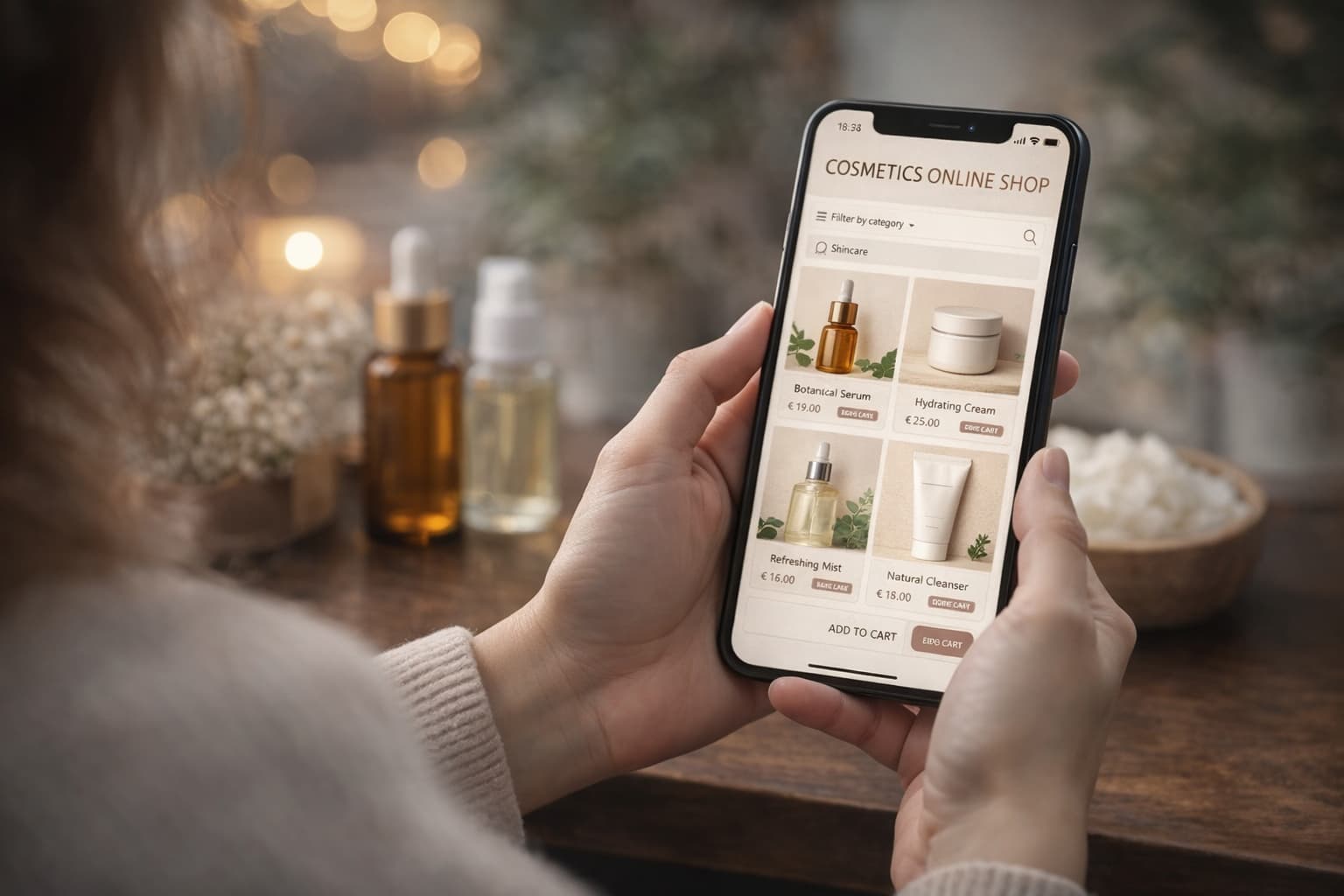
Mobile optimisation is a must – over 60 % of purchases start on a smartphone
SEO for product pages
- Keyword research:Find out what your target audience is searching for (e.g. “buy natural soap”, “handmade face cream”). Use these terms in the title, description and alt texts
- Unique product copy:Never copy manufacturer texts. Write your own detailed descriptions of at least 200–300 words per product
- Alt texts for images: Describe every product image with a meaningful alt text. This helps with Google image search and accessibility
- Blog content: Write articles about your ingredients, production and application tips. This brings long-term organic traffic and demonstrates expertise
Social media
- Instagram: Ideal for visual products. Show the production process, behind-the-scenes and customer feedback. Use Reels for more reach
- Pinterest:An underrated channel for cosmetics. Pins on “DIY natural cosmetics” or “handmade gift ideas” bring long-term traffic
- TikTok:For younger audiences. Short videos on the production process or “ingredient spotlights” work well
- Email marketing: Collect email addresses (GDPR-compliant!) and send regular newsletters with new products, discount campaigns and care tips
If you sell soap, our guide to making and selling soap offers further marketing tips specifically for natural soaps. And for creams we recommend our guide to making and selling cosmetic creams.
Checklist: your cosmetics online shop ready for launch
All done? Use this checklist to make sure your handmade cosmetics shop is ready for launch:
1. Business registered
Business licence in hand, tax-registration questionnaire completed, VAT option chosen.
2. Products cleared
Safety assessment (CPSR) passed, CPNP notification done, PIF complete.
3. Shop set up
Platform chosen, design customised, domain set up (if your own shop).
4. Legal texts complete
Legal notice, withdrawal policy, privacy policy, terms and conditions – all linked and up to date.
5. Product pages optimised
INCI list, PAO, warnings, nominal content, product images, description – everything in place.
6. Packaging & shipping
Packaging-register registration done, compliance scheme joined, shipping provider chosen.
7. Payment & accounting
Payment provider set up, invoice template created, accounting tool connected.
8. Marketing prepared
Social media profiles created, first posts scheduled, SEO basics implemented.
9. Product liability insurance
Insurance taken out that covers cosmetic products (from around 150–300 €/year).
10. Test order carried out
Order and payment process tested, confirmation emails checked, shipping simulated.
For the GMP-compliant documentation that matters at point 2, we recommend our GMP guide to ISO 22716. And you will find the current requirements for ingredients in our article on the changes to the EU Cosmetics Regulation in 2026.
Frequently asked questions (FAQ)
Do I need a registered business to sell cosmetics online?
Yes. As soon as you sell cosmetics regularly and with the intention of making a profit, you need a registered business. To start with, a small business (sole proprietorship) is enough. Business registration costs 20–65 € depending on your local authority. You'll find the details in our guide to registering a home cosmetics business.
Which platform is best for a cosmetics online shop?
That depends on your budget and your technical skills. Etsy is ideal for a quick, low-effort start (from 0 € in fixed costs). Shopify offers the best compromise between flexibility and simplicity (from 36 €/month). Your own WooCommerce shop gives you full control but requires technical know-how.
Do I have to show the INCI list in my online shop?
Yes. The EU Cosmetics Regulation (EC) 1223/2009 requires the ingredient list (INCI) to be accessible to the consumer. In bricks-and-mortar retail it appears on the packaging. In an online shop you must also show it on the product page – ideally clearly visible and complete.
What does it cost to open a cosmetics online shop?
The pure shop costs start at 0 € (Etsy) and go up to around 36 €/month (Shopify). On top of that come transaction fees (3–5 %), a domain (10–15 €/year), possibly a legal-text generator (from 9 €/month) and shipping costs. The biggest cost items, however, are often the upstream obligations: the safety assessment (300–1,500 € per product), CPNP notification and product liability insurance.
May I advertise my cosmetics as “healing” or “medicinal”?
No. Cosmetic products may not claim any medicinal or healing effects – that would breach the EU Cosmetics Regulation and the rules on advertising medicinal products. Permitted cosmetic claims include “nourishes”, “protects” or “moisturises”. Prohibited statements include “treats acne”, “relieves eczema” or “medically effective”.
Conclusion: opening your cosmetics online shop – legally sound and professional
Opening a cosmetics online shopis easier today than ever before – but the legal requirements should not be underestimated. The good news: if you already have a safety assessment, are CPNP-notified and have registered your business, you have already cleared the biggest hurdles.
In summary, for a successful start you need:
- The right platform: Etsy for testing, Shopify for growing
- Legally sound texts: legal notice, withdrawal policy, GDPR, terms and conditions
- Complete product pages: INCI, PAO, warnings, good images
- Packaging & shipping: packaging-register registration, compliance scheme
- Clean documentation: GMP-compliant raw-material and formulation data
The key to success: do it right from the start. If you document your raw materials cleanly, create INCI lists correctly and work in a GMP-compliant way, you will not only have less stress during authority inspections – but also a professional basis for the shop, for natural-cosmetics certification and for your customers’ trust.
Further resources
- How to sell homemade cosmetics legally: the complete guide
- Registering a home cosmetics business: step by step
- Creating an INCI list: a guide for cosmetics manufacturers
- GMP for cosmetics: the complete guide to ISO 22716
- EU Cosmetics Regulation (EC) 1223/2009 (EUR-Lex)
- LUCID packaging register (official website)
Want to document your formulas and INCI lists professionally?
INCIkit brings formulas, INCI declaration and batch documentation into one app — free for 14 days, no credit card required.
INCIkit Editorial
Cosmetics Compliance Desk
More articles
Starting Your Own Cosmetics Brand: From Idea to Finished Brand
Want to start your own cosmetics brand? This hands-on guide shows you the way step by step — from brand concept and logo through product line and packaging to distribution, marketing and a realistic cost overview.

Lip Balm, Bath Bombs & Co: The Best Starter Products for Your Cosmetics Business
Which cosmetic product is the easiest to start with? We compare 6 categories — from lip balm through bath bombs to body oils — by complexity, cost, shelf life and regulation.
Labels for Handmade Cosmetics: Mandatory Details & Design Tips
Your cosmetic label must not only look good — it must also contain 8 mandatory legal details. This practical guide shows you which details are mandatory, how to design professional labels and where to have small runs printed.