
Labels for Handmade Cosmetics: Mandatory Details & Design Tips
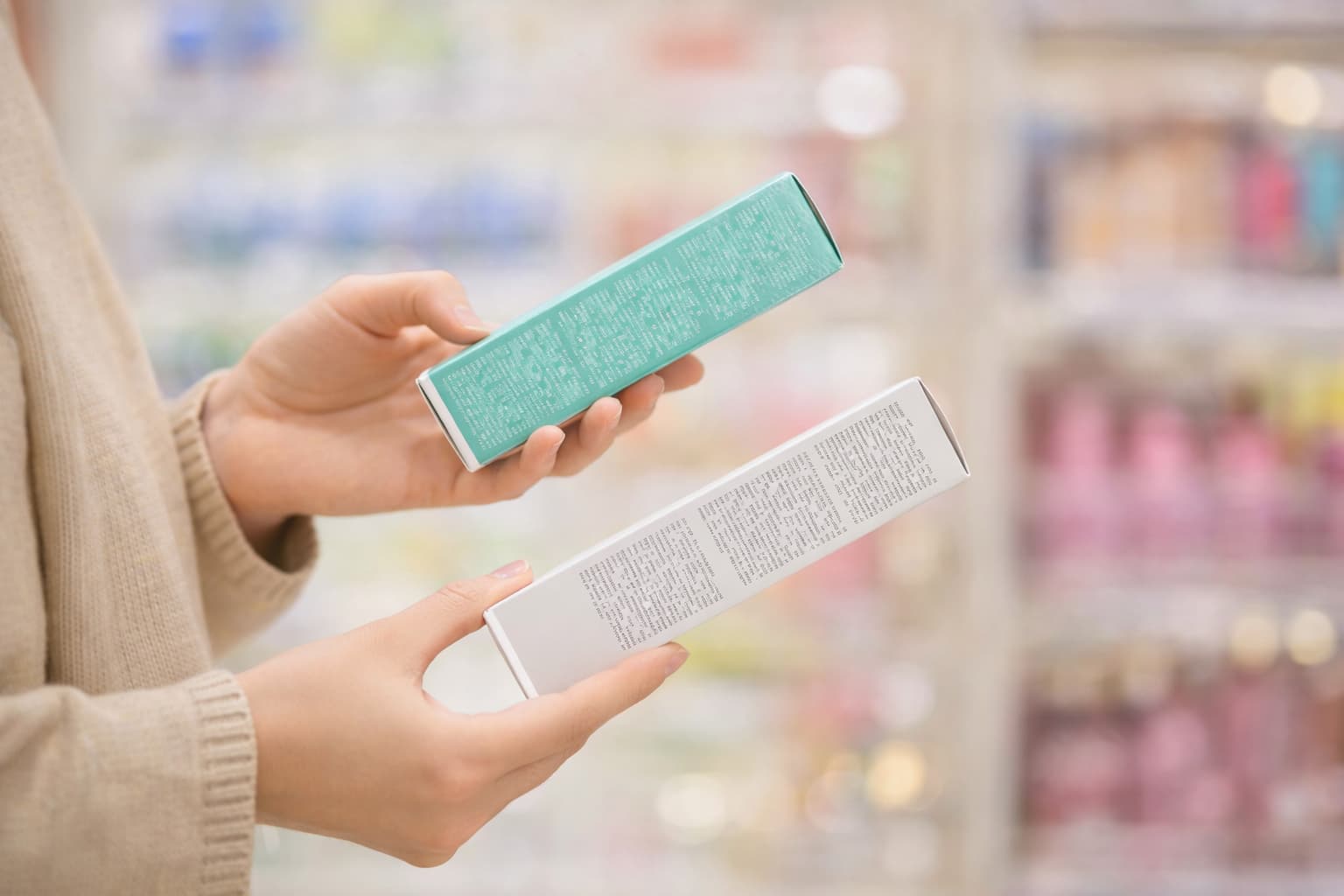
Your label looks great – but is something important missing? Anyone who wants to design cosmetic labels themselves has to consider more than just pretty design. The EU Cosmetics Regulation (EC) 1223/2009 prescribes 8 mandatory detailsthat belong on every cosmetic product – whether soap, cream or lip balm. If a detail is missing, you risk warning letters, fines and, in the worst case, a sales ban.
This practical guide shows you step by step which cosmetic label mandatory details you need, how to place them correctly and how you can still create a professional cosmetic label– even on a small budget and without any graphic-design skills. Including design tips, a print service comparison and a list of the most common mistakes made by small-scale producers.
Not yet sure which legal foundations apply to your sales? Then start with our guide: selling homemade cosmetics legally. And for the correct INCI declaration, our step-by-step guide to the INCI list.
The 8 mandatory legal details for cosmetic labels
Article 19 of the EU Cosmetics Regulation (EC) 1223/2009 sets out which information must appear on the packaging of every cosmetic product. These cosmetic packaging mandatory details apply to every batch size – even to 10 units of handmade soap:
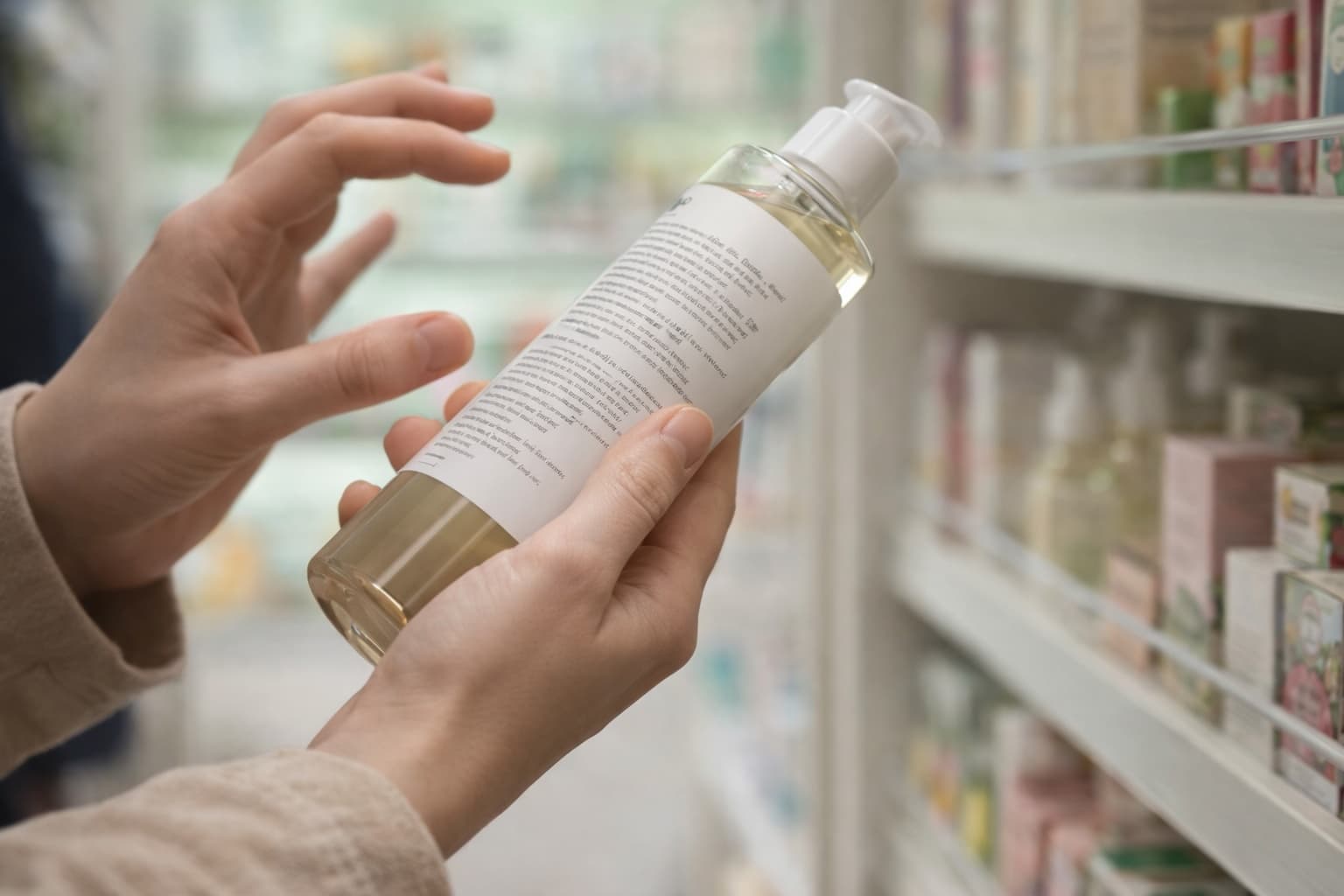
Consumers expect complete ingredient information – and so does the law
Product name (function)
What is the product? E.g. “hand soap”, “moisturiser”, “lip balm”. Your fancy name (“Sunset Glow”) does not count – the function must be recognisable.
INCI list (ingredients)
A complete list of all ingredients in the international INCI nomenclature, sorted in descending order of concentration. Details on this in the next section.
Nominal content (quantity)
Weight or volume at the time of filling. In grams (g) or millilitres (ml). Example: “100 g” or “50 ml”. For bar soaps the weight is sufficient.
Name and address of the responsible person
Your full company name and your postal address. For sole traders: your name + street + postcode + town. Not just an e-mail address or website – the physical address is mandatory.
Batch number (batch no.)
A unique number for tracing every production batch. Without a batch number no recall is possible. More on this further below.
Best-before date or PAO symbol
Date of minimum durability (for a shelf life of < 30 months) orPAO symbol “Period After Opening” (for > 30 months). Never both at the same time.
Intended use
Only required if the purpose is not obvious. For “hand soap” it is clear. For a multi-purpose balm (“For lips, hands and soles of the feet”) the intended use must be stated.
Warnings and precautions
Certain ingredients require legally prescribed warnings (e.g. essential oils, certain allergens, UV filters). Annexes III–VI of the EU Cosmetics Regulation list all the substances concerned and the prescribed wordings.
Important: country of origin for imports
Do you import raw materials or have production carried out abroad? Then the country of origin must also be stated. For products manufactured in Germany this is not required – but it is possible on a voluntary basis (“Made in Germany”).
The INCI list on the label: font size, order, exceptions
The INCI list is the most important and at the same time the most error-prone part of your label. Here are the rules:
Order
All ingredients must be listed in descending orderof concentration. Exception: ingredients below 1 % may appear in any order at the end. Colourants are given using the CI system (Colour Index) and always come last.
Special rules apply to soaps: saponified olive oil is declared as “Sodium Olivate”, not as “Olea Europaea Fruit Oil”. You will find all the details in our guide to making and selling soap.
Font size
The EU Regulation requires at least 1.2 mm x-height(the height of the lower-case letter “x”). In practice that corresponds to roughly 6 pt font size in common typefaces. Tip: test your label as a printout – on screen everything looks larger than in reality.
The heading “Ingredients”
The INCI list must be introduced with the word “Ingredients” (in English, without a colon). This is uniform across the EU – including in Germany. Many small-scale producers accidentally write “Inhaltsstoffe” or “Zutaten” – both are wrong.
For creating your INCI declaration correctly, we recommend our detailed creating an INCI list: step-by-step guide.
PAO symbol vs. best-before date: when do you need which?
One of the most common mistakes on cosmetic labels: manufacturers print both the PAO andthe best-before date on the packaging – or neither of them. The rule is simple:
| Criterion | PAO symbol | Best-before date (hourglass) |
|---|---|---|
| Shelf life | > 30 months | < 30 months |
| Symbol | Open jar + figure in months (e.g. 6M, 12M) | Hourglass + date (MM/YYYY) |
| Typical products | Soaps, lip balm, anhydrous products | Creams, lotions, products containing water |
| Typical for small producers | More common (soaps, balms) | For emulsions containing water |
Practical tip
If you are unsure whether your product keeps for longer than 30 months: the safety assessment determines the shelf life. Your toxicologist or safety assessor gives you the precise figure for the PAO or best-before date. When in doubt: the best-before date is the safer choice.
Anyone making creams should pay particular attention to shelf life – emulsions are more susceptible than anhydrous products. More on this in our making and selling creams guide.
Batch number: why it is mandatory and how to assign it
The batch number (batch no.) is your life insurance: in the event of a recall you must know exactly which products are affected. Without a batch number on the label no targeted recall is possible – and that can become very expensive.
How to assign batch numbers
There is no prescribed format, but your system must be unique and traceable. Proven formats for small-scale producers:
Date-based
Format: YYMMDD-NO, e.g. “260315-01” = first batch on 15/03/2026. Simple, sortable chronologically.
Product prefix
Format: [product code]-YYMMDD, e.g. “LS-260315” = lavender soap, 15/03/2026. Ideal if you make several products.
Sequential
Format: B001, B002, B003 … Simple, but with no date reference. Practical only with a small number of products.
The batch number on the label must match your internal documentation (batch record). This allows you to demonstrate, in an authority inspection, which raw materials (with LOT number) went into which product. You will find more on GMP-compliant documentation in our GMP guide to ISO 22716.
Small packaging: what to do when there is not enough room?
Lip balm tubes, 15 ml jars, small bars of soap – on many products from small-scale producers there is simply no room for all 8 mandatory details. The EU Cosmetics Regulation is aware of this problem and offers solutions:
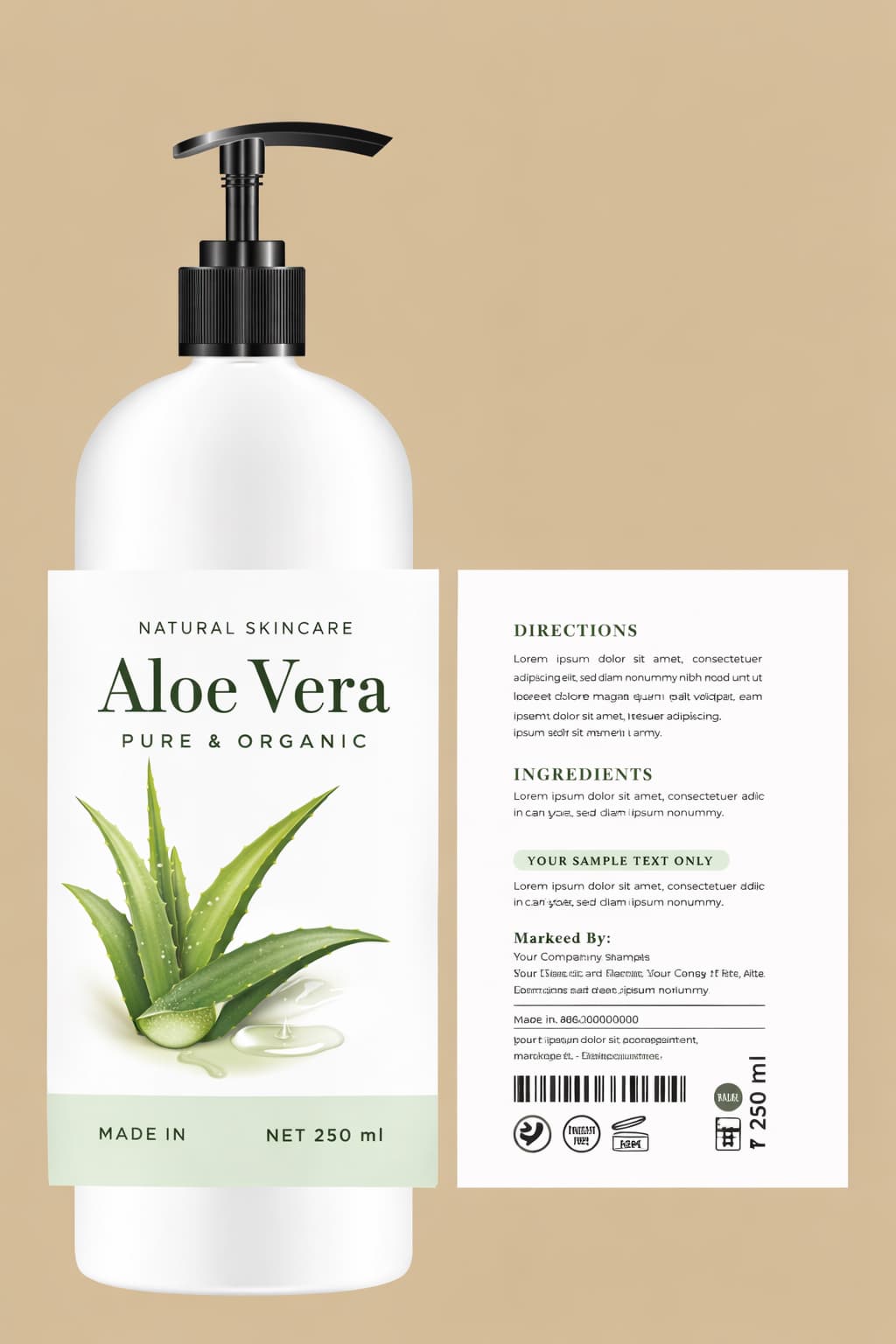
Even on small products all mandatory details must find room somewhere
Use outer packaging
If the primary label is too small, some of the mandatory details may be moved to the outer packaging (box, carton, banderole). The INCI list then goes on the box, while the batch number and the nominal content stay on the product itself.
Package leaflet or tag
For packaging under 10 ml/10 g where outer packaging is not possible either, the Regulation permits a package leaflet or a tag. The customer must be pointed to it at the point of sale (e.g. by a reference symbol on the label).
What must always stay on the product?
Even on small packaging, the following must always be directly on the product: batch number, PAO/best-before date, nominal content and the name of the responsible person. These four details may not be moved to the outer packaging.
Design tips: professional soap label designwith Canva & Co
Mandatory details and beautiful design are not mutually exclusive. With the right tools you can create professional cosmetic labels even without a degree in graphic design:
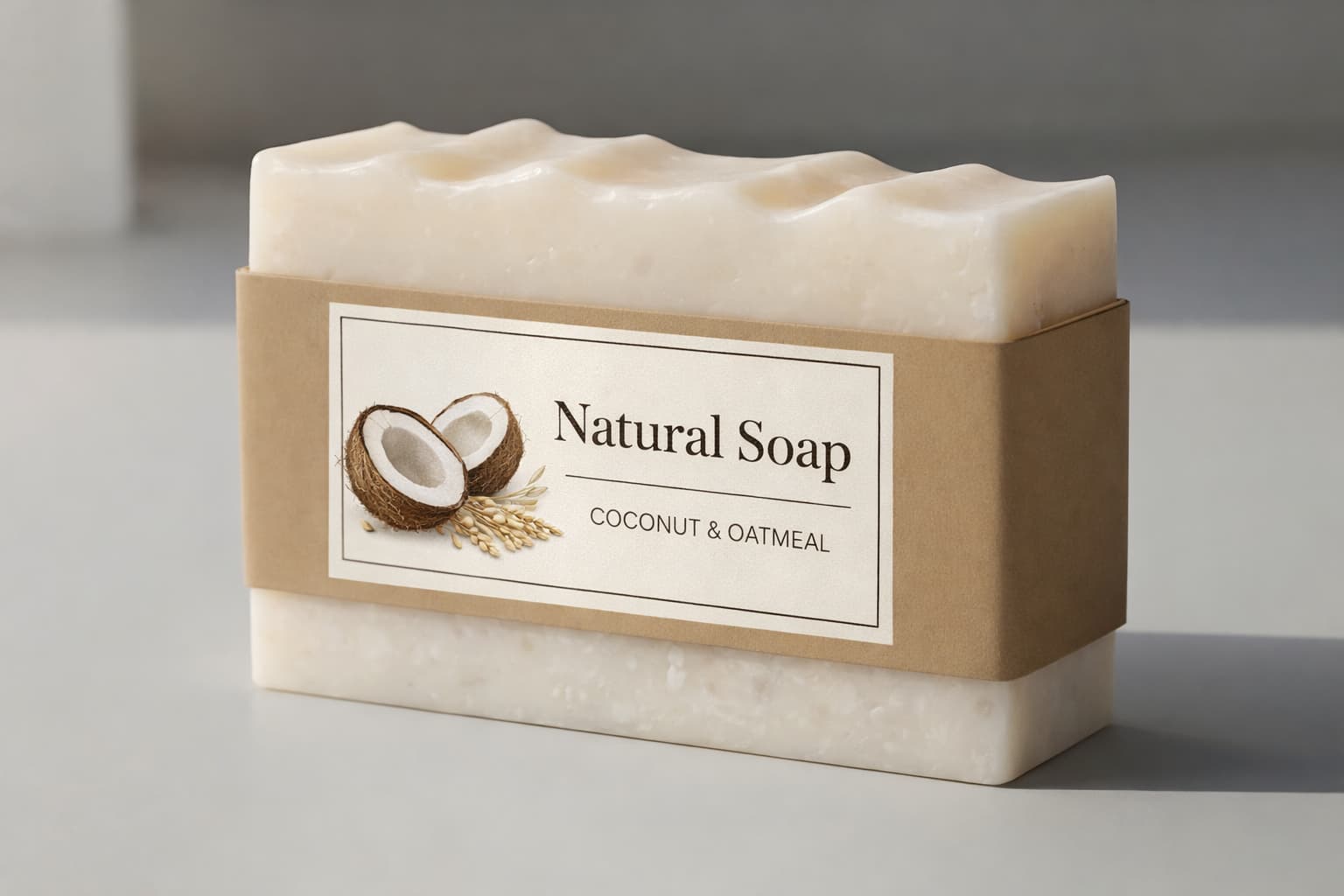
Minimalist label design on kraft paper – professional and handmade
Canva (free / from 12 €/month)
The all-rounder for beginners. Custom dimensions, thousands of templates, export as a print PDF. Tip: use “Custom design” with the exact dimensions of your label in millimetres.
Adobe Illustrator / Affinity Designer
Professional tools with vector graphics, bleed and CMYK export. The learning curve is steeper, but you get full control over typography and print output. Affinity is an affordable one-off purchase (approx. 70 €).
Avery Zweckform Design & Print
A free online tool made specifically for Avery labels. Choose your label format, design directly in the browser and print onto Avery sheets. Ideal for entry-level runs.
5 design rules for cosmetic labels
- Legibility before beauty: mandatory details must be legible. Do not use script fonts for the INCI list
- Contrast: dark text on a light background (or vice versa). White text on a pastel background is almost illegible
- Hierarchy: product name large, function medium, INCI list and mandatory details small but legible
- Consistent design:use the same font, colour palette and layout structure for all products – this creates recognisability
- Plan for bleed:leave 2–3 mm of bleed on all sides – otherwise the printer will cut into your design
Create your INCI list and copy it straight onto the label
INCIkit generates your INCI declaration automatically from the formulation – correct order, correct nomenclature, ready to copy instantly for Canva, Illustrator or your print service.
Print service comparison for small runs
Large print houses print from 1,000 units – but as a small-scale producer you may need only 50 or 100 labels. Here are the best options for small runs:
| Provider | Minimum run | Price / 100 units | Notable feature |
|---|---|---|---|
| Avery Zweckform | 1 sheet (8–16 units) | from 5–10 € | Self-print, free online designer |
| Onlineprinters | from 25 units | from 15–30 € | Professional printing, many materials |
| StickerMule | from 50 units | from 20–40 € | Fast delivery, sticker specialist |
| Moo | from 50 units | from 25–50 € | Premium quality, special formats |
| Your own laser printer | 1 unit | from 2–5 € | Flexible, but limited quality |
Budget tip for getting started
Start with Avery Zweckformand a laser printer: buy water-resistant label sheets, design in the free online designer and print yourself. From around 200 units it becomes worthwhile to switch to an online print service like Onlineprinters – the unit price then drops significantly.
Common labelling mistakes among small-scale producers
From our experience with hundreds of small manufacturers, we know the typical pitfalls. Check your label for these 9 mistakes:
1. “Inhaltsstoffe” instead of “Ingredients”
Across the EU, the INCI list must be introduced with the English word “Ingredients” – not “Inhaltsstoffe”, “Zutaten” or “INCI”.
2. Wrong INCI order
Ingredients must be sorted in descending order of concentration. A common mistake: alphabetical sorting or an arbitrary order.
3. Missing batch number
Without a batch no. no recall is possible. Some manufacturers forget it entirely or print it only on the box rather than on the label.
4. PAO and best-before date together
Either the PAO symbol OR the best-before date – never both. Which one you need depends on the shelf life (the 30-month rule).
5. Incomplete manufacturer address
“SoapLove, Berlin” alone is not enough. It must be the full postal address: name, street, postcode, town.
6. INCI text too small
Below 1.2 mm x-height the INCI list is not legally compliant. Always test with a printout, not just on screen.
7. Saponified oil declared incorrectly
Sodium Olivate (saponified olive oil) ≠ Olea Europaea Fruit Oil (olive oil). Special INCI designations apply to soaps.
8. Missing function description
A fancy name like “Golden Dreams” is no substitute for the function description. It must be recognisable what the product is.
9. Warnings forgotten
Certain essential oils, allergens and UV filters require legally prescribed warnings. Check Annexes III–VI of the EU Cosmetics Regulation.
You will find the full requirements for cosmetic documentation – including the PIF, CPNP notification and GMP – in our specialised guides:
- Creating a PIF: content, structure and practical tips
- CPNP notification: guide + typical mistakes
- EU Cosmetics Regulation 2026: what is changing
Frequently asked questions (FAQ)
What font size must the INCI list have on the label?
The EU Cosmetics Regulation requires a minimum font size of 1.2 mm (x-height of the lower-case letters). For very small packaging under 10 ml/10 g, you may fall back on a package leaflet, a tag or a sticker. In practice we recommend at least 6 pt font size – that corresponds to roughly 1.5 mm and is easy to read.
Do I need a PAO symbol or a best-before date?
It depends on the shelf life: if your product keeps for longer than 30 months, you need the PAO symbol (an open jar with a figure in months, e.g. 6M). If it keeps for less than 30 months, you need a best-before date (date of minimum durability) with the hourglass symbol instead. For soaps with a very long shelf life, the PAO symbol is the standard.
May I print my labels with an ordinary inkjet printer?
Technically yes, but we advise against it: inkjet printing is not waterproof and smudges on contact with moisture – a problem for cosmetics in the bathroom. For small runs (from 25 units) we recommend a laser printer with water-resistant stickers or an online print service such as Avery Zweckform or Onlineprinters.
What must appear on the label of a handmade soap?
The same 8 mandatory details as for any cosmetic product: product name, INCI list, nominal content (e.g. 100 g), name and address of the manufacturer, batch number, PAO symbol or best-before date, intended use (if not obvious) and warnings (if required). For soaps the INCI order is particularly tricky, because saponified oil is declared differently from the starting oil.
Can I design my label entirely in Canva?
Yes, Canva is excellent for cosmetic labels. Use the “Custom size” function for exact dimensions, choose an easily legible font (at least 6 pt for the INCI list) and export as a PDF with crop marks. But make sure all 8 mandatory details are included – Canva does not check this automatically.
Conclusion: designing cosmetic labels yourself– combining compliance and creativity
Anyone who wants to design cosmetic labels themselvesfaces a double challenge: the label must contain all 8 mandatory legal details andlook professional. The good news: with the right tools (Canva, Avery Zweckform) and this guide you can achieve both – even without a graphic-design budget.
In summary:
- 8 mandatory detailsunder Article 19 of the EU Cosmetics Regulation – none of them optional
- INCI listintroduced with “Ingredients”, sorted in descending order, at least 1.2 mm font size
- PAO or best-before date– never both, depending on the 30-month rule
- Batch number– indispensable for traceability and recall
- Small packaging: outer packaging or a package leaflet as the solution
The most efficient route: create your INCI list digitally, copy it straight into the label design and document everything traceably. When you open your cosmetics online shop, you also need the INCI list on the product page – with a digital tool you handle both in a single step.
Further resources
Want to document your formulas and INCI lists professionally?
INCIkit brings formulas, INCI declaration and batch documentation into one app — free for 14 days, no credit card required.
INCIkit Editorial
Cosmetics Compliance Desk
More articles
Starting Your Own Cosmetics Brand: From Idea to Finished Brand
Want to start your own cosmetics brand? This hands-on guide shows you the way step by step — from brand concept and logo through product line and packaging to distribution, marketing and a realistic cost overview.
Lip Balm, Bath Bombs & Co: The Best Starter Products for Your Cosmetics Business
Which cosmetic product is the easiest to start with? We compare 6 categories — from lip balm through bath bombs to body oils — by complexity, cost, shelf life and regulation.
Start a Cosmetics Online Shop: A Legally Sound Launch for Small Producers
Want to sell your handmade cosmetics online? This hands-on guide compares Etsy, Shopify and WooCommerce, explains all the legal obligations and shows you how to build product pages, shipping and marketing the right way.