
Make and Sell Your Own Cream: Your Route to a Market-Ready Product
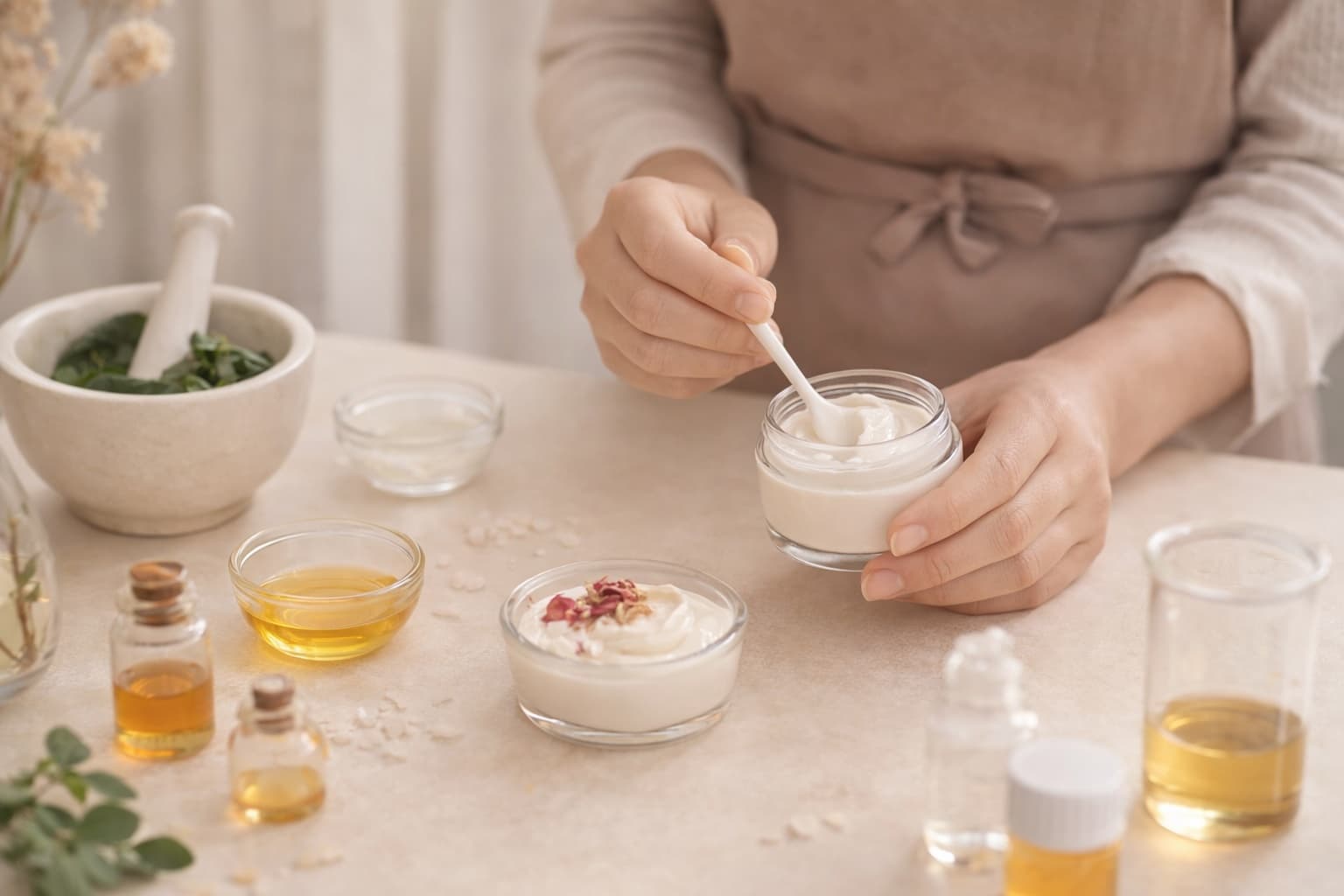
Your moisturiser is better than anything on the drugstore shelf – friends and family confirm it at every opportunity. But are you actually allowed to just sell it on Etsy or at the weekly market? The good news: yes, you can make and sell your own cream. The important news: creams are more demanding in regulatory terms than soaps or lip balm because they contain water – and water means preservation, stability tests and stricter hygiene standards. This guide shows you step by step what you need to bear in mind – with concrete costs, practical tips and the most common mistakes you should avoid.
Looking for a general overview of all five steps that apply to every cosmetic product? Then start with our guide: how to legally sell homemade cosmetics. This article focuses specifically on the particularities of creams, lotions and emulsions.
Creams vs. soaps: why emulsions are especially demanding
What makes a cream so much more complicated than a soap? The key word is emulsion. A cream is a mixture of water and oil that is stabilised by an emulsifier. This combination brings three challenges that don’t exist with anhydrous products such as soaps, body butters or lip balm:
| Challenge | Soap / balm | Cream / lotion |
|---|---|---|
| Microbial risk | Low (no free water) | High – preservation mandatory |
| Stability | Stable (solid form) | Can separate or go rancid |
| Challenge test | Rarely needed | Almost always mandatory |
| Safety assessment cost | 300–600 € | 500–1,000 € |
| Hygiene requirements | Standard GMP | Increased (sterile tools, clean environment) |
This doesn’t mean you’re not allowed to sell cream – but you do have to invest more time and money in the preparation. If you’re only just starting out and want to make and sell your own cream, read the following sections particularly carefully.
Preservation: mandatory, and the most common mistakes in DIY creams
Preservation is not optional for creams – it is the single most important safety measure. As soon as your product contains water, bacteria, yeasts and moulds can multiply. An unpreserved product can become dangerous for the consumer – skin infections, eye irritation or allergic reactions are possible consequences.
Approved preservatives
The EU Cosmetics Regulation (EC) 1223/2009 lists all approved preservatives together with their maximum concentrations in Annex V. The most common ones for small cream producers:
| Preservative | INCI | Max. concentration | Suitable for |
|---|---|---|---|
| Phenoxyethanol | Phenoxyethanol | 1.0 % | Creams, lotions |
| Ethylhexylglycerin | Ethylhexylglycerin | 0.5–1.0 % | Booster for phenoxyethanol |
| Potassium sorbate + sodium benzoate | Potassium Sorbate, Sodium Benzoate | 0.5 % each | Suitable for natural cosmetics (pH < 5.5) |
Common mistake
Many DIY producers believe that vitamin E (“Tocopherol”) or essential oils would preserve adequately. That is notthe case. Vitamin E is an antioxidant (it protects oils from going rancid), but not a preservative against bacteria. Essential oils do have antimicrobial properties, but they are nowhere near enough for a passing challenge test.
Shelf life & stability tests: what you have to test before selling
Before you can make and sell your cream, you need robust shelf-life data. The safety assessor needs this data to establish the shelf life and classify the product as safe.
Two types of test
1. Stability test (long-term + accelerated)
- Room temperature (20–25 °C): after 4, 8 and 12 weeks, check appearance, odour, consistency, pH value and colour
- Accelerated ageing (40 °C): simulates faster ageing – 3 months at 40 °C correspond to roughly 12 months at room temperature
- Cold stability (4 °C): important for emulsions – some separate in the cold
2. Challenge test (preservative efficacy test)
A laboratory deliberately inoculates your product with bacteria (Staphylococcus aureus, Pseudomonas aeruginosa, Escherichia coli), yeasts and moulds. After 7, 14 and 28 days it measures whether the microbial count drops sufficiently. Cost: 150–400 € per product. Duration: approx. 4–6 weeks.
Practical tip: start the tests in parallel
Start the challenge test and the stability test at the same time as your safety assessment. That saves you 2–3 months of waiting. The toxicologist can often begin the assessment on the basis of the formulation and submit the test results later.
PAO symbol (open jar): when you need it
PAO stands for “Period After Opening” – the length of time your product can be used safely after opening. The PAO symbol is the open jar with a number (e.g. “6M” for 6 months, “12M” for 12 months).
PAO or best-before date – which do you need?
- Best-before date (minimum durability date): mandatory if the shelf life is under 30 months. Shown as an hourglass symbol + date
- PAO symbol:mandatory if the shelf life exceeds 30 months. This applies to most well-preserved creams
- Both together:not necessary – it is either the best-before date or the PAO
For most homemade creams the rule is: if your stability tests show that the product keeps for at least 30 months, you use the PAO symbol. Typical PAO values for creams are 6M (jar without dispenser) or 12M (pump dispenser, lower risk of contamination).
Safety assessment for creams: special considerations for emulsifiers
The safety assessment is more complex for creams than for soaps because the toxicologist has to examine additional factors. You can read more about the general procedure in our guide to the safety assessment. Here are the cream-specific aspects:
What the toxicologist additionally checks
- Emulsifier system: which emulsifiers do you use? Are they approved for leave-on products? (Some emulsifiers are only suitable for rinse-off)
- Preservation system:is the concentration sufficient? Does the system match the pH value of your formulation? (Potassium sorbate, for example, only works below pH 5.5)
- Challenge test result:does your product pass the preservative efficacy test according to the criteria of ISO 11930?
- Water activity (aw value): how much freely available water does your product contain? The higher it is, the stricter the requirements for preservation
- Phase separation: is the emulsion stable in the long term, or is it prone to creaming?
Costs for creams vs. soaps
For a cream safety assessment, budget 500 to 1,000 €– that’s 100–200 € more than for a simple soap. The surcharge is due to the additional assessment of the preservation and emulsifier system. Anyone who wants to make and sell their own face cream should factor in this budget.
Creating the correct INCI order for creams
The INCI list for a cream follows the same basic rules as for any cosmetic product: ingredients above 1 % are sorted in descending order by percentage by weight, those below 1 % in any order. With creams, however, there are a few particularities:
Typical INCI order of a cream
Example: INCI list for a moisturiser
Aqua, Prunus Amygdalus Dulcis Oil, Cetearyl Alcohol, Glycerin, Butyrospermum Parkii Butter, Ceteareth-20, Phenoxyethanol, Ethylhexylglycerin, Tocopherol, Lavandula Angustifolia Oil, Linalool, Limonene
Particularities with creams
- Aqua is almost always in first place– water makes up 50–80 % of most creams
- Emulsifiers have to be declared – even if they only make up 2–5 % (e.g. Ceteareth-20, Glyceryl Stearate)
- Preservatives appear far down– typically below 1 %, i.e. in the lower part of the list
- 26 fragrance allergenshave to be declared individually from a concentration of 0.001 % (leave-on)
You can find a detailed guide with all the rules in our INCI list guide.
Create the INCI list for your cream automatically
INCIkit automatically sorts your ingredients by concentration, knows all the emulsifier and preservative INCI names, and documents batches without any gaps.
GMP on a small scale: hygiene standards for your kitchen workshop
GMP (Good Manufacturing Practice) under ISO 22716 sounds like something for big industry – but it also applies to you as a micro-producer. With creams, hygiene is especially critical because water promotes microbial growth. Our GMP guide to ISO 22716 explains the details. Here are the most important points for cream producers:
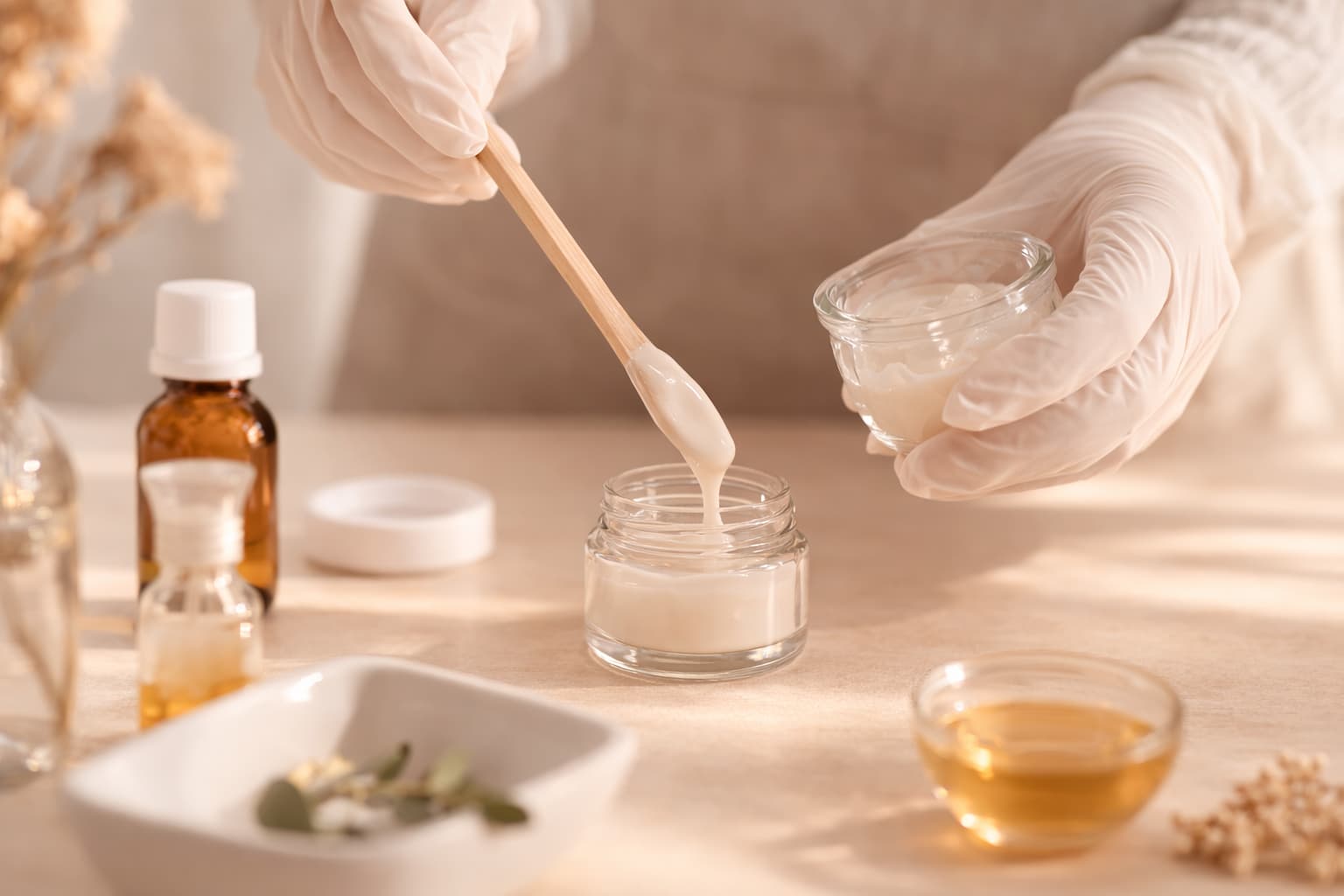
Hygienic filling with gloves – GMP even on a small scale
Separate work area
Keep manufacturing separate from everyday life – a clean table in a separate room is enough, but the kitchen while you are cooking is not suitable.
Disinfected tools & containers
Disinfect all equipment, spatulas, jars and containers with 70 % isopropanol before use, or boil them out. This is especially important with creams!
Protective clothing
Disposable gloves, a clean apron, hair tied back. No jewellery on your hands.
Documented cleaning records
Note down when, how and with what you cleaned your work area and your tools. The safety assessor will want to see this.
Raw material storage
Store oils cool and dark. Keep water-containing raw materials (oil-in-water emulsions, aloe vera gel) in the fridge after opening.
Batch documentation
Every production batch gets a unique number (e.g. “260319-01”). Note down: date, raw materials used with LOT numbers, quantities, manufacturing steps, temperature and pH value.
Packaging & label for creams and lotions
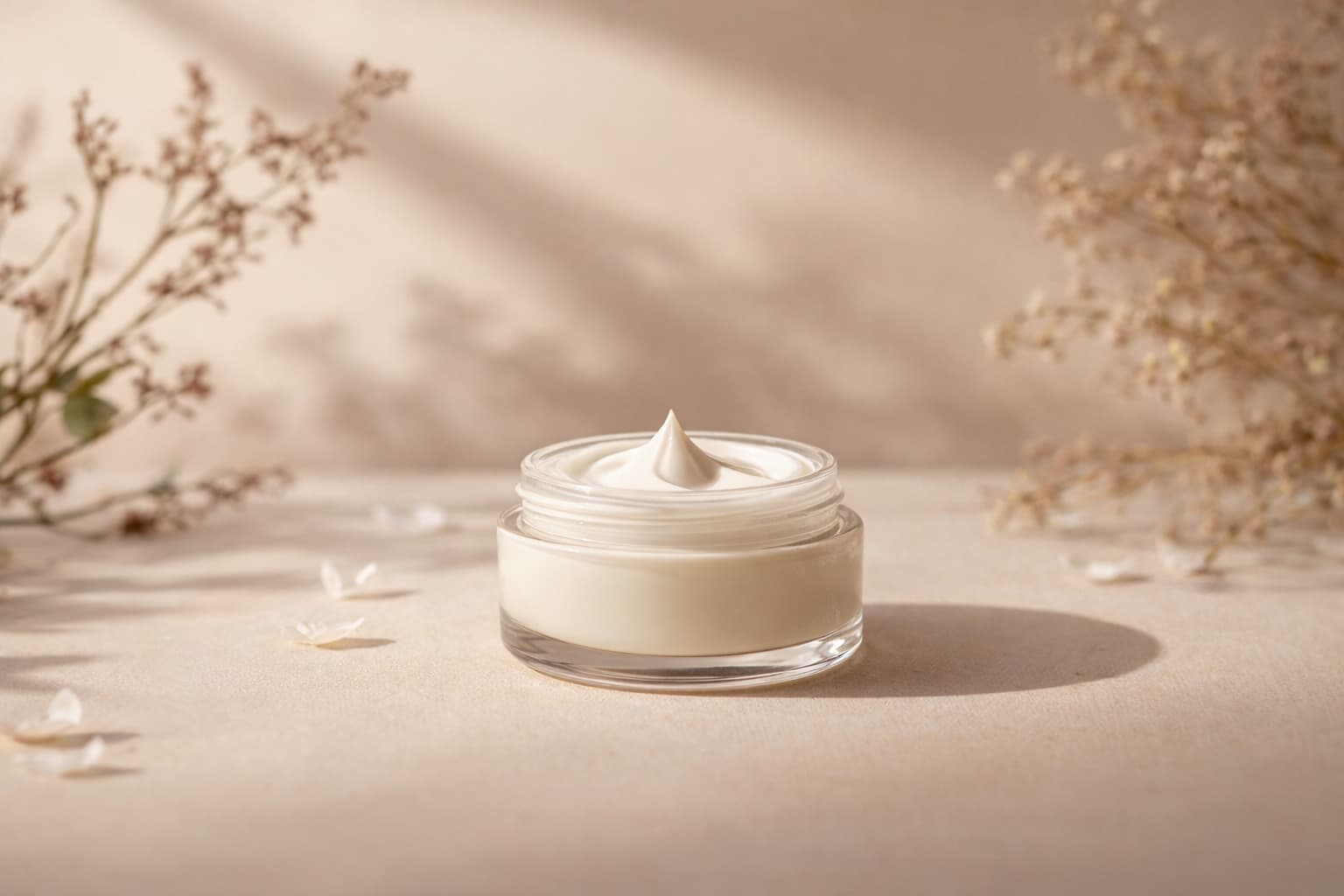
Attractive packaging – but all mandatory details have to be on it
With creams and lotions you have more packaging options than with soaps – but also more to bear in mind:
Jar vs. pump dispenser vs. tube
| Packaging | Advantages | Disadvantages | PAO |
|---|---|---|---|
| Glass jar | High-quality look, reusable | Finger contact → higher risk of contamination | 6M |
| Pump dispenser | No finger contact, hygienic | More expensive, not suitable for all consistencies | 12M |
| Aluminium tube | Airtight, hygienic, good protection | Minimum order often 500+ units | 12M |
Label: the 8 mandatory details
For creams the same 8 mandatory details apply as for all cosmetic products (Art. 19 of the EU Regulation): product function, name/address, nominal content, best-before date or PAO, precautions, batch number, INCI list and country of origin. Particularly important for creams:
- Nominal content in ml (not grams as with soaps)
- The PAO symbolis almost always required (creams usually keep for over 30 months)
- A storage note(e.g. “Store in a cool, dry place”) is recommended
You can find all the details on labelling and the PIF in our articles on the PIF practical guide and on the CPNP notification. If you’re only just starting out and want to make and sell your own body lotion, we also recommend the overview of the EU Cosmetics Regulation 2026.
Frequently asked questions (FAQ)
Do I have to preserve my homemade cream if I want to sell it?
Yes, absolutely. Every cream contains water, and water is the ideal breeding ground for bacteria, yeasts and moulds. Without an effective preservation system your product can become contaminated within a few days. Without a challenge test (preservative efficacy test) the safety assessment will generally not pass. Approved preservatives are listed in Annex V of the EU Cosmetics Regulation.
What does it cost to get a cream approved for sale?
For your first cream product you should budget 600 to 1,500 €. The safety assessment costs 300–800 €, the challenge test 150–400 €, and stability tests around 100–300 €. On top of that come the business registration (20–60 €) and packaging/labels. Creams are more expensive than soaps because the challenge test is almost always mandatory.
How long do I have to run stability tests?
At least 3 months at room temperature (20–25 °C), plus accelerated ageing at 40 °C and cold stability at 4 °C. Check regularly: appearance, odour, consistency, pH value and colour. For a best-before date of 12 months, many toxicologists recommend at least 6 months of real-time stability data.
Do I need two separate safety assessments for a face cream and a body lotion?
Yes. Every formulation needs its own safety assessment – even if only the concentration of a single ingredient differs. That said, many toxicologists offer discounts for product families when the base formulation is similar. Ask in advance about a package price.
Can I make and sell cream without an emulsifier?
Technically yes – there are anhydrous products such as body butters or balms that don't need an emulsifier. However, these don't count as “creams” in the narrower sense. As soon as you want to combine water and oil in an emulsion (which is a cream), you need an emulsifier. Without an emulsifier the phases separate and the product is unstable.
Conclusion: make and sell your own cream – achievable, but with respect for the regulation
Making and selling your own creamis more demanding than soaps or lip balm – but absolutely achievable once you know the particularities of emulsions. Preservation is mandatory, stability tests and a challenge test are indispensable, and the hygiene requirements are higher than for anhydrous products. But don’t let that put you off: thousands of small producers across the DACH region successfully sell their handmade creams.
Invest in a solid formulation, work cleanly from the very start and document everything. The total cost for your first product is around 600 to 1,500 € – after that every additional product becomes cheaper. And if you start with a simple soap, you gather valuable experience before you take on creams.
Further resources
Want to document your formulas and INCI lists professionally?
INCIkit brings formulas, INCI declaration and batch documentation into one app — free for 14 days, no credit card required.
INCIkit Editorial
Cosmetics Compliance Desk
More articles
Starting Your Own Cosmetics Brand: From Idea to Finished Brand
Want to start your own cosmetics brand? This hands-on guide shows you the way step by step — from brand concept and logo through product line and packaging to distribution, marketing and a realistic cost overview.
Lip Balm, Bath Bombs & Co: The Best Starter Products for Your Cosmetics Business
Which cosmetic product is the easiest to start with? We compare 6 categories — from lip balm through bath bombs to body oils — by complexity, cost, shelf life and regulation.
Labels for Handmade Cosmetics: Mandatory Details & Design Tips
Your cosmetic label must not only look good — it must also contain 8 mandatory legal details. This practical guide shows you which details are mandatory, how to design professional labels and where to have small runs printed.